Current, Future, Past

School without Walls
School without Walls is an intragenerational experience, an aesthetic research expedition that explores naturecultural ecologies. Unfolding in a direct relationship with the living world SwW invites to nurture perception and awareness beyond a reductionist view of nature, expanding sensitivity and ways of listening to the more-than-human world, through personal and collective storytelling, art thinking and making, as well as a process of larger-self-discovery, recognising intertwined relations as meaningful with intensity and nuance. As an artefact of personal meaning participants make books (in an expanded sense of a 2 or 3 D object) and contribute to a collective publication >> Foresta Kids Ecologies Magazine (a Mook: magazine+book) .

Process
We work with a format of an aesthetic embodied research that holds space for participants’ personal inquiries and offers frame for their effortless self to lead them through our propositions, develop their own questions in relation to the proposed theme, reflect on shared experiences, invent stories, observe, document, and express. Proposed activities include artistic interventions, body-related explorations, handcrafted invitations and aesthetic practices such as collecting, sketching, painting, printing, etc, as well as more scientific methods such as research, documentation, conservation, comparison, relating, etc. enable participants to understand and engage with their questions from a variety of perspectives. Thoughts, images, experiences, emotions and impressions are collected by the participants and shaped into their personal research books or other artefact, as well as become part of a collective publication at the end. Our task as a team is to have confidence in participants’ curiosity, to give impulses rather than answers, and to offer support when needed.

Depending on the theme and the chosen space, SwW wanders through the city, forest, or a country-side, balancing between indoors and outdoors. In the past editions SwW took place in a botanical garden, a museum, a library, a park, a kitchen, a bookshop, the streets, and other urban spaces that were not only connected with the theme of SwW, but also facilitated unusual and unconventional work processes. Questions we explored in the past were: What would it be like to be a bird? Do trees have secret lives? How does nature live in cities? Are we nature? What is human nature? What is human impact on nature? How do we balance our existence with all the other creatures inhabiting the planet?

Context
SwW tries to offer the soil, to terraform for new narratives that nurture attentiveness, integrity and care as a mindset and a living practice. In this context we see a need for a different approach to education, one that supports human and ecological wellbeing. Our understanding of meaningful education is continuously evolving, but could be currently described as:
supporting people to develop a deeper awareness of the world(s) around and within
nurturing broader perspectives and understandings of interconnections and varieties of life contexts (historical, geographical, natural, social, cultural, and in-betweens) within both a local and a planetary outlook
creating conditions for flourishing within personal and relational ecologies (that include self-awareness and capacity to find one’s organic place in the world, multiple intelligences and poetic capacities, empathy and respectful togetherness with otherness, abilities to make informed and eco-literate decisions and adapt to changing life situations)
Education Mojo (as part of Woods in the City series) offers further insights into our long-term research on educational practices.
Characteristics
* Nomadic (SwW takes place in diverse naturecultural places, indoors and outdoors)
* Intragenerational (open for people of different ages, as long as they are able to make the decision to join by themselves)
* Multilingual (we support multilingual environments, our working languages are: Deutsch, English, Español, Français, Русский )
* Phenomenon- and context- based (disciplines are not separated — it’s not about art, or science, or learning how to sing. It’s about experiencing a chosen subject from a variety of perspectives)
* Personal research (learning is rooted in self-directed inquiry)
* Renewal of relations (SwW is part of the larger Foresta Collective’s work as a platform for regenerative practice)

Personal Museum
museum experience as a MER (Museum for Ecological Re-story-ation)

Personal Museum is a playful experience designed for and with children, for a more joyful, attentive, interactive and meaningful time in museums. It invites children to engage with works of art through direct association with their own life rather than abstract concepts.

Personal Museum Book
This experience is built around a simple book that we design for a specific museum, connecting art history and curiosity about a personal experience of the artworks of every child. We wish to inspire kids to approach the artworks closer, to sense and feel them, to let them reflect children’s own lives back to them. These books include a variety of exercises and games that encourage kids to look closer at the artworks, to sharpen their attention, to express their personal vision of things and draw something themselves, to work alone and with a partner, to play a movement game and to be still, and so on.
Exploring the Senses
In the world where we so often live in the digital and virtual, this module is about exploring sensory perception. Children spend a lot of time in front of the screens, and sometimes for hours a day they just use their eyes to gather information. The visual sense is very direct, it shows, it states “what is”. The sense of smell, touch, hearing, taste, allow us to perceive reality on multiple levels, to develop attention and experience how they are allied with the notions of the body, emotion and cultural memory. Looking at the paintings or sculpture or other artworks is only one part of the experience. What olfactory memories do artworks evoke? Who can interpret artworks in smells? How about sound? This module invites into a variety of warm-my-senses-up exercises, and offers to experiment with smells, sounds, tactile and even taste experiences, depending on the chosen subject.
Storytelling Journey
This module is designed as a game for attention, interaction, association, and creation. The entire experience can be for a group between 3 and 20 children, and lasts between 1 and 2 hours. The experience creates a reflective space for participants to notice inner resonance with the artworks, to exchange with others. It tries to enhance participants’ ability to notice and reflect upon personal feelings and motivations reflected through the artworks, without the immediate need to act upon them, as a real-life situation would require. There is an exhibition of participants’ improvised works at the end of each game.

Personal Museum in Berlin 2017-2020
Woods in the City KIDS
collective practice lab for teens
WOODS IN THE CITY Kids is a lab for the future-curious teens. In this series we hold space for experimenting different possibilities and imaginaries for work life of the future, as a playground for self-determination that is not predefined. Clearly, certain kids of work appear to have particular value for society and look more or less attractive. Currently this value is mainly determined by media, education, family. But what would young people do if they were actually free to decide what they want, free from others’ expectations? At the same time, some of the future professions are not yet known to us. In a rapidly changing world, it is not clear today what new professions there will be in the future. Inviting guests from diverse walks of life to participate in the Woods, we want to introduce young people to different ways of being and acting in the world. Contributors give participants an insight into their world, their perceptions and forms of expression, to offer a glimpse into how different the paths to a fulfilled professional life can look like and how rich non-standard ways can be.


This workshop invites to explore the great outdoors and to find yourself as part of it. It aims to encourage children’s intuitive and experiential understanding of the living worlds in the age of digital technologies. It also tries to remind that humans are part of nature, and invites to explore the metaphors of the inner forest. Children are naturally attentive to wonders, beauty and diversity of natural surroundings, as well as their own imagination and fantasy. At the heart of Books of Forests is attention and care for nature, inner and outer. We explore relations between forests around us and inside us, in direct and metaphorical ways. And we make personal and collective books about/from/as findings on the way.


Impressions from workshops at Botanical Garden Berlin-Pankow, Bode Museum, Naturkundemuseum Berlin, Helmholzplatz, M24, Schule an der Strauchwiese, Werkstatt, Young Arts Neukölln, and Spazio Corsivo. Lead by: Sabina Enea Teari, Violeta Lopiz, Carolina Celas, Andrea Antinori. Images: Foresta Collective

The starting point for this project was a wish to explore water as a habitat, as a life form that is also a home to multitudes of life forms. Together with a group of children we pondered on contemporary questions and tensions around current ways of coexistence between humans and other beings on the planet. So on the one hand this project unfolded through attentiveness and wonder at the beauty of rivers, seas and other water bodies, and also through exploring the challenges of interspecies co-habitation that we are currently experiencing on Earth (biodiversity loss, pollution,..). Everything else that unfolded in the project came out of our encounter and exchange with a group of children, as well as the condition of being outdoors only (due to Covid).
We were lucky that the project location was right at the river Spree in Berlin. So we could not only rely on our personal and collective memories and fantasies of water worlds, but meet the river Spree, contemplate its waterscape, draw and paint its movements and colours, give attention to its qualities and creatures that live in and around the water: animals, fish, plants, birds, and many guests like human-made objects and rubbish. We also explored questions around empathy towards these very different from us beings. Kids are very aware of the problem of waste in the rivers, seas and oceans. To express concern and compassion with their favourite creatures inhabiting water, they drew portraits of their rivers, seas and oceans. Together we made water filters, as well as a collective sculpture of a whale, to express our wish for more human attention and care for the oceans, rivers, lakes, streams, seas and other bodies of water.
Another part of the project was related to the inner water worlds. One of the kids said that we are also 70% water, just like the Earth. What does that mean? Can we feel our inner water? And if we also have water inside, does someone live there? They say emotions flow. Maybe these inner water inhabitants are our emotions? Noticing how they feel as a daily practice, children recorded their feelings as beings. Such emotional creatures cannot usually be seen, they can only be felt. And sometimes it is difficult to share how you feel. So we made a kind of emotion x-ray from a transparent plexiglass. Depending on how you feel today, you could stand accordingly and hold the plexiglass at the height of your belly (we found that we usually feel things there). This way your friends can see how you are feeling today and understand you better.
Project commissioned by KinderKünsteZentrum in Berlin
Participating children: FRÖBEL-Kindergarten Inselkinder Berlin
Exhibition on display at KinderKünsteZentrum between 20 May and 30 September 2021

Images: Sabina Enéa Téari, Musashi Shimamura, Ines Grabner

This series of 8 intragenerational workshops to reconnect to sense-based intelligence took place as part of School without Walls in 2019, in format of aesthetic research dedicated to sound, smell, taste, touch, sight, as well as the sense of self and sense of empathy. How many senses do we have really anyway? Senses as balance, interoception, proprioception, gravity, or even sensing magnetic fields, or a Japanese concept of MA as a sense of place, are rarely mentioned as real senses. We look at everything that enables perception of ourselves as well as tuning our sensory apparatus to other creatures and life forms around us, as senses that need to be recognised and noticed. During this Senses Series we experiment, explore, express, and experience sensuously, accompanied by a mobile creativity suitcase, that provides art materials for recording personal and collective experiences from the journey and making an own book of senses, as well as contributing to a collective Mook (magazine + book). Impressions here.

This 3-day spatial storytelling journey took place between 3d and 5th of August 2021 at Kulturgarten Hödurstrasse in Berlin. It invited children to notice the multitudes of creatures inhabiting the more-than-human landscapes of the city. Whom do we encounter when we step out of our home? Which living landscapes ask for our deep attentiveness and careful observation? Inner listening is just as important: through a process of exploring effortless movement, playful interactions, and free abstract painting participants create fantasy worlds, translating inner landscapes onto paper, that are then transformed into their personal journey books. These books will contain various languages of expression: words, images, sounds, shapes, colours,… In them we explore pluralities of pre-verbal orchestras of intangible languages. As David Abram asks in his book Becoming Animal, can we find ways of speaking that call us back into rapport with the other beings, the other living shapes and forms of this world?


How does growth happen in nature? What happens between a seed and an apple? Bottom to Top is a workshop focused on the subject of a tree as a living being and a living space. We go on a journey of exploration together with children and finish by feasting and celebrating nature and harvest. We move from the roots to the fruit, from one area to another exploring life of a tree — where does it grow, what does it see around, how does it feed, how does it breathe, what does it feel, who are its friends, what or whom is it scared of. We learn about its inhabitants and the architecture of their houses. We experiment with colours and smells. We build a tree together — from the roots to the crown. Commissioned by Skolla, this workshop took place in Berlin’s Botanischer Volkspark Blankenfelde-Pankow in collaboration with other creative practitioners.

Images: Sabina E. Téari, Maryna Markova

“Being the Forest” series explored the forest from different perspectives. As a representation — we looked into the history of arts to find examples of how humans depict and interact with forests. As an experience — we shared stories from travels, and went on short explorations of urban nature. As a feeling — we collected memories and dreams. As imagination — we made our own forest installation from real and imaginary ingredients, individual and collective dreams, working with diverse materials (such as paper, cardboard, clay, leafs, sticks, colours, found objects) and techniques (observing, drawing, painting, sculpting, storytelling, light installation). The project aimed to raise attention and care for the living forests, to reconcile the world of arts, humanities and sciences in children's everyday experiences. Traces of the forest made by children became part of the window exhibition in Berlin-Neukölln. Commissioned by KinderKünsteZentrum in 2018. Parts of the series at KinderKünsteZentrum in collaboration with Varvara Polyakova and Samuele Huynh Hong.

Workshop and exhibition at KiKüZ

Window exhibition in Neukölln

Spiders are remarkable beings. Animals in our homes, working and public spaces we barely notice. These 8-legged creatures often wake up our fear, disgust, and fascination, intertwining. But do we really pay attention to their lives? Do we notice them climbing the walls, spinning their webs, dancing, swimming, changing skin, and even growing back lost limbs? How are little spiders born? What’s their favourite food? Why is their blood blue or green? Who was living on Earth earlier, a spider or a dinosaur? Why are spiders a vital part of our ecosystem? How did spiders make it into mythology and legends of so many cultures and civilizations? Do spiders dream?
In this project a group of children accompanied by a team of artists from a variety of expressive media backgrounds (visual arts, movement, photography, wood-work, aesthetic research) pays attention to the world of spiders from a human perspective, and then, flipping the roles, looks at the world of humans from a perspective of a spider. The relationship between weaving and storytelling is as old as time. During this project with a help of several threads we bind together spoken and visual storytelling, movement and stillness, sound and silence, observation and imagination. We attempt to weave a new story of relationships between humans and spiders.
Team for this series: Sabina Enéa Téari, William Veder, Michelle Bruce, Nathaniel Therrien, Egor Sviri. Intern post-production: Camille Brabant. Production and Organisation: Karen Hoffmann, Melanie Rothe. The project took place in 2019 at Casa Fantasia, NaturkundeMuseum, Studio Tomás Saraceno, parks and streets. Commissioned by the children museum KinderKünsteZentrum in Berlin. Exhibition patron: Studio Tomás Saraceno.

Images: Sabina Enéa Téari, Nathaniel Therrien, Studio Tomás Saraceno, William Veder


This workshop invites to peek into the invisible worlds, to dance, draw, and model our emotions. We ask ourselves many questions: 'what is an emotion', 'how can emotions be described?', 'where do emotions come from?', 'what triggers an emotion?', 'are emotions important in everyday life?’. Through this journey of paying attention, identifying, observing, and expressing emotions, children made intuitive creatures. We used the impulses from body movement and spontaneous drawing for this creation. Drawings were then transformed into 3D creatures made of wire and fine aluminium mesh. Finally, the project ended with the staging and lighting up of the creatures in a light installation. In collaboration with Alice Baillaud. Took place at Heinrich-Seidel Schule, Bibliothek am Luisenbad, Olof-Palme-Zentrum. Commissioned by Kinder Kultur Monat in 2018.

Images: Sabina Enéa Téari

In this workshop series we looked at the history of books, how and why did books develop, how the invention of writing and drawing contributed to the expansion of our intelligence as species, what kind of materials were used to make books in the old days in different parts of the world. We were learning about history, visited museums, experimented with materials and made our own stone books, wooden books, papyrus books, parchment books, paper books, small books, large books, accordion books, elephant books, illustrated books, story books… In collaboration with Violeta Lopiz. Series took place at Werkstatt Berlin, Neues Museum, Naturkunde Museum. Commissioned by Kinder Kultur Monat 2017.

Images: Sabina Enéa Téari

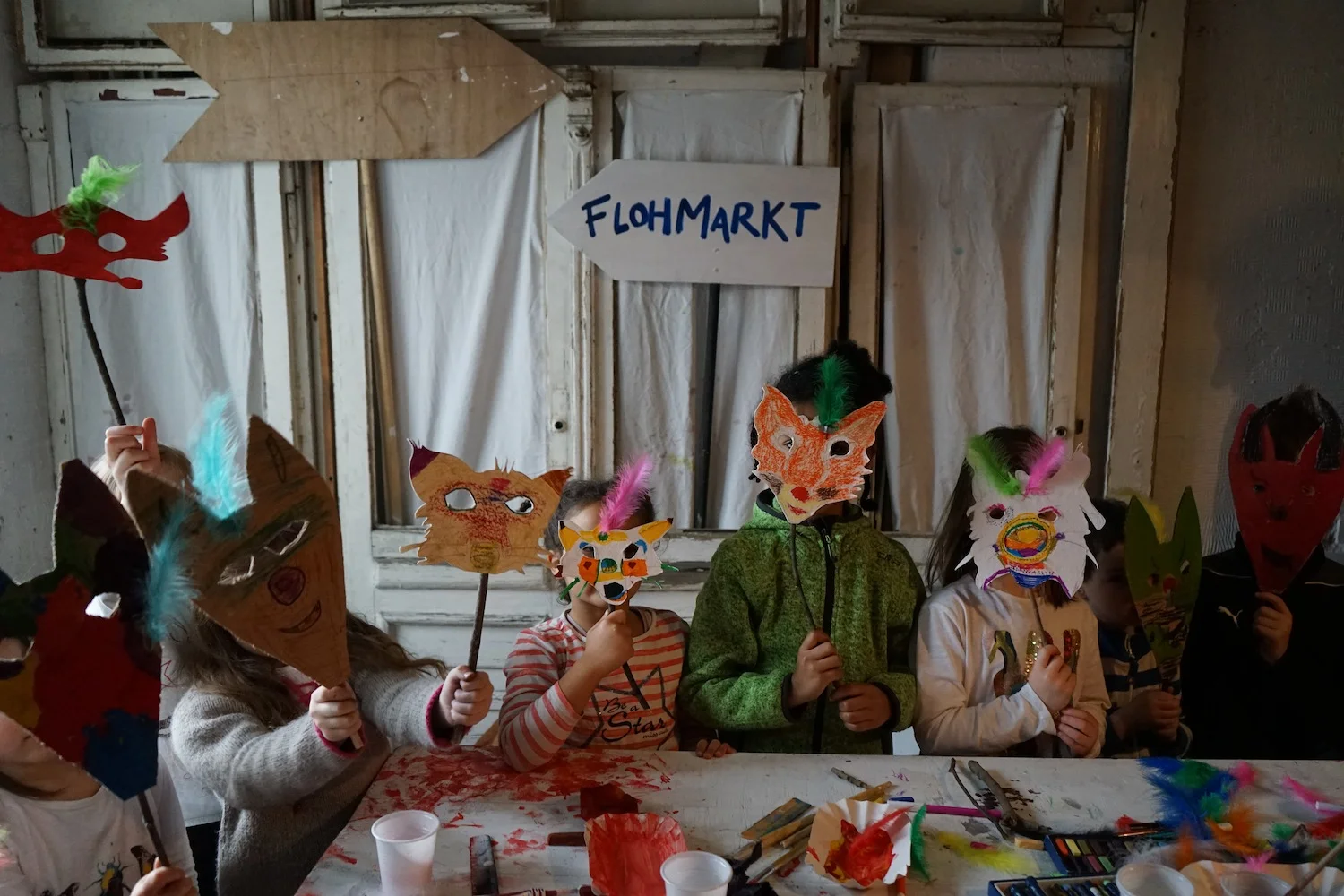
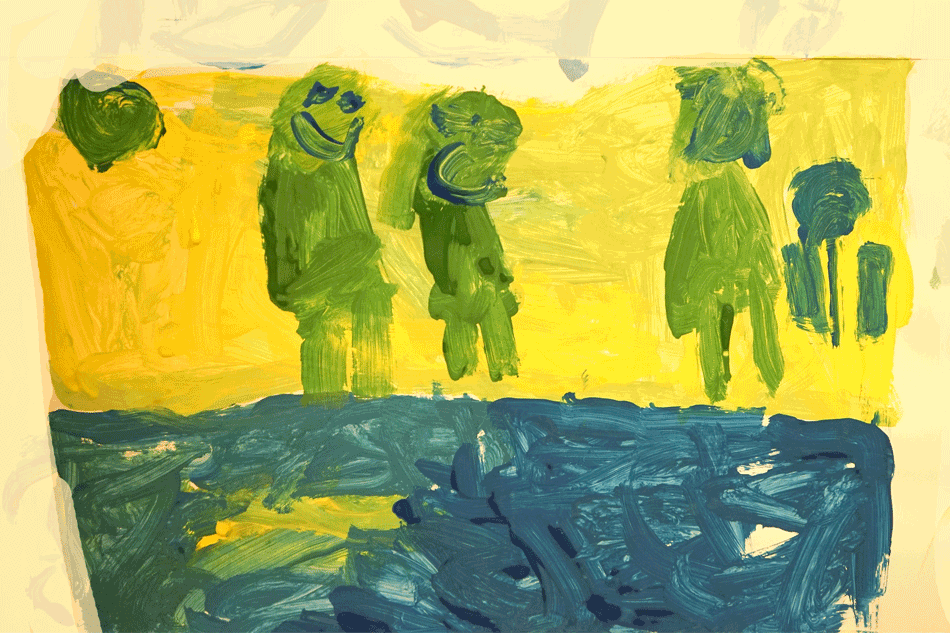
“When I was a Rhino…” is a creative storytelling exploration through painting, movement, drawing, stop-motion animation and play. It unfolded as a series of 4 consecutive meetings to explore storytelling through different media. We begin with experimentation and free movement practice. On the way we add colours and in playful interactions children paint with the whole body, leaving colourful traces everywhere. Through this process of intuitive abstract painting and association children create landscapes and fantasy worlds. They invent stories about creatures who live there – in drawing, in playing, in sharing. From the stories and drawings of children together we make a short animation film. As the next step on the journey children themselves turn into characters in their own stories. Together we create costumes and masks so they really become elephants, Nif-Nifs, trees, flowerpots, snowflakes, or any other creatures they chose to be. Dressed up, they act out their stories interacting with each other, while we film these encounters. At the end of this journey we have created a short film about our adventures together: an interplay between animation and theatrical performance. Team for this series: Sabina Enéa Teári, Romy Blümel, Egor Sviri. Here you can see the video of the story.

Images: Sabina Enéa Téari, Romy Blumel

In this 3 months long project children experimented with, designed, inhabited, and transformed experiences of space (small and large scale) as an expression of their individual and collective imagination. It was also an inquiry into spaces where they feel well, and a way to empower kids to make their own environments aligned with what they like. Along the course of this workshop series children created imaginary worlds from different types of paper, cardboard, colours: making sculpture, building structures, personal spaces, houses, animals’ homes, and collective environments, combining it all with movement, painting, drawing, storytelling, and interactive multimedia experiences, as well as learning to build with diverse materials and work collaboratively. Prehistoric cave paintings were an inspiration in the process, where we also imagined how the ancient humans saw the world, how they lived, what was important to them. In collaboration with Kirstin Broussard and Alessandro Maggioni. The series took place at Campus Rütli, KiKüZ. Commissioned by KinderKünsteZentrum in 2016.

Images: Sabina E. Téari, Kirstin Broussard, Alessandro Maggioni

Propositions is a project for young children, which involved precisely that — propositions from the side of adults: we propose time, materials, space, where children can themselves discover possibilities and find out what and how they want to do with what we offer. These interventions and proposals for kids take off from a place of paying close attention to particular group of children, their current interests and fascinations. Noticing reality of what they are living at the moment, we can join the interests that they show in organic and respectful ways, based on active pedagogy, honest relation, and arts as ways of thinking and making. Commissioned by Nurserine in Paris in 2019.

Images: Sabina E. Téari

Through the body we express ourselves, who we are and what we feel. We speak, we sing, we write, we move, we draw and paint, we do all kinds of things where our heart, mind, hands and the whole being create and leave inner marks on the outer world. In these meetings with children we explore how our posture, or the way we move, and the way we breath are connected to how we feel. Does every expression leave a mark? Body is also a source of imagination. What if everything around us would sound? What if every object could easily turn out to be a living being? How would we feel living in another body? What if we all were part of one large body? Can we draw with the whole body? Can we draw on the body? Can our bodies make music? These meetings are about imagining and celebrating the body in all forms. Sounding body sculpture created in collaboration with Playtronica. The series took place at INA.Kindergarten. Commissioned by KinderKünsteZentrum 2017.

Images: Sabina Enéa Téari

Workshop impressions

Exhibition at KiKüZ
In times when the digital and virtual take so much of our time and attention, Senses labs propose to explore sensory perception, expanding it beyond the visual realm. These days children spend a lot of time in front of the screens, and sometimes for hours a day they just use their eyes to gather information. The visual sense is very direct, it shows, it states “what is” and often does not leave much room for the imagination. The sense of smell, touch, hearing, taste, and others are strongly connected with experiences of the body, emotions and cultural memory.
We’ve been developing senses-related interventions for kindergarten children, school kids, teens, and educators. For example, the project “Home is where the nose is” was dedicated to the sense of smell. It combines interpersonal communication, chemistry, psychology, neuroscience, botany, movement and art. With this project we wanted to spend time exploring the world around through the sense of smell, developing attention for scents, making our own scents, telling stories through scents. Commissioned by Skolla for teens between 13 and 15 at Heinrich-von-Stephan Gemeinschaftsschule Berlin.

Images: Sabina Enéa Téari, Maryna Markova

As human beings, we live in two worlds: the outer and the inner. We couldn’t agree more with Ken Robinson, who writes about our ability to know the world around us only through the world within us, through the senses by which we perceive it and the ideas by which we make sense of it. Our lives are formed by the constant interaction and interplay between these worlds, each affecting how we see and act in the other. Inside Outside invited children to explore in simple and playful ways the outer and the inner worlds of the body. We asked questions about what we are made of, what organs as well as feelings live in us, what we can perceive through our senses, and how we relate to our bodies through imagination. We learned how every body has a lot in common with each other, and at the same time how everybody is unique. We worked with different materials and explored various techniques, such as drawing, sculpting, painting, sensing, sounding, printing, making collage, moving, shadow tracing, as well as some basic meditative practices of paying attention. The series aims to raise self-awareness, curiosity, and appreciation of the body. The series took place at INA.Kindergarten Prenzlauerberg. Commissioned by KinderKünsteZentrum in 2017.

Images: Sabina Enéa Téari

How do we live in the cities and how do cities live in us? As a Russian street artist Radya writes in his urban art manifesto, our whole inner world is linked to the city; this connection is perpetuated through all of our senses. The city is the footprint we leave behind. It’s a faithful imprint of our times and ideas. The relationship between the inner and the outer worlds is the key element of street art. In this series of workshops we explored questions of How do children and young people imagine the city they genuinely want to live in? What do they miss in cities of today? What could cities of the future be like? And how can we continue bringing these dreams into reality?
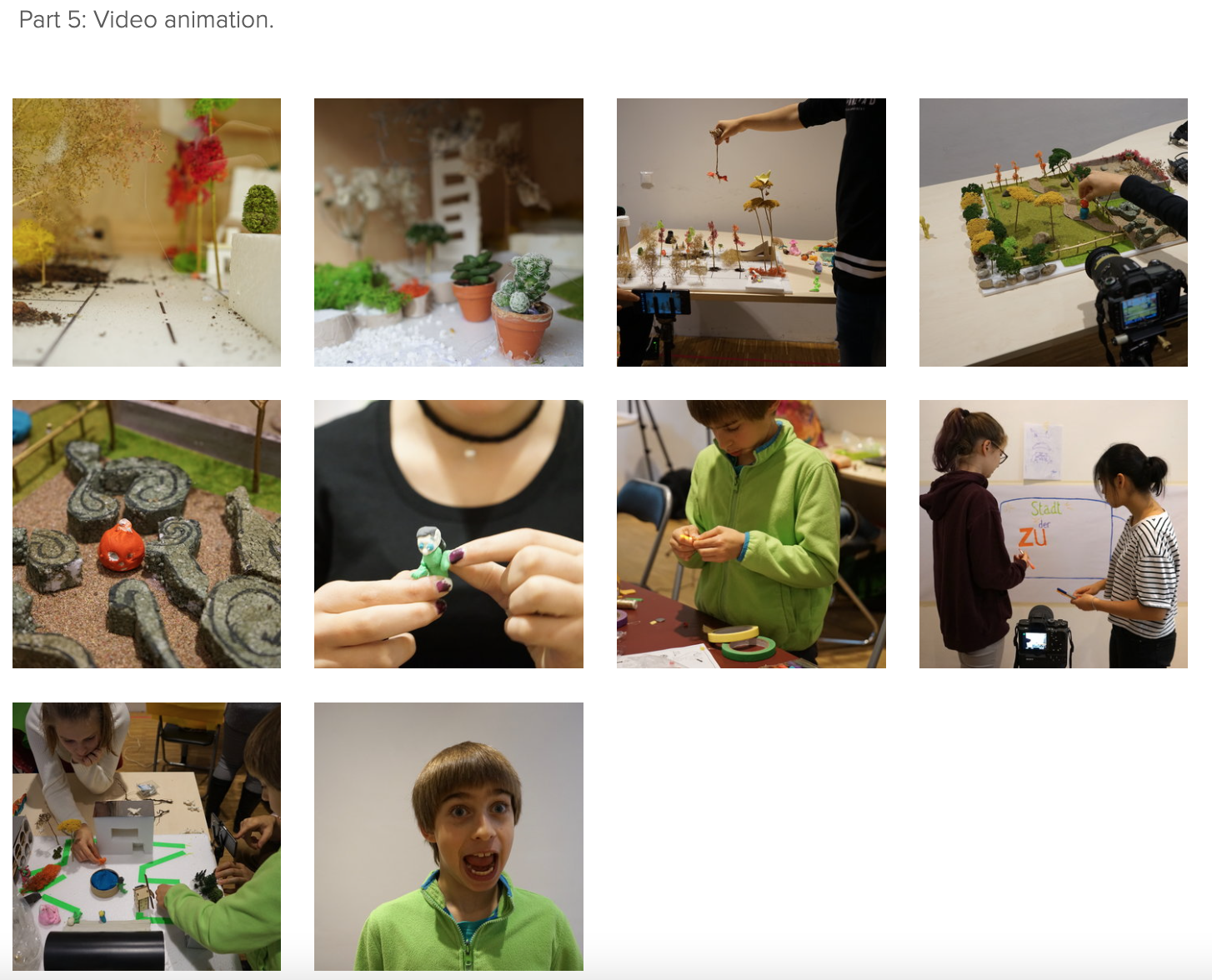
This interdisciplinary project with teens at the intersection between architecture, urbanism, landscape design and conviviality took place at Bauhaus Campus Berlin in 2017. Reflecting, imagining, playing, thinking, planning, feeling, building, shaping, filming. We thank our partners and collaborators: Skolla, Bauhaus Museum Campus Berlin, Van Bo Le-Mentzel, Katja Schneider, Cristian Wiesenfeld, Sophie Jackson. Video work that teens made as well as the making-of impressions here.


Into the Night

Into the Night is an installation and a workshop for families. It’s a merged experience between making and playing, participating and observing, works of “artists” and works of “visitors”. The space is transformed by the power of collective imagination, as we set out for a nocturnal exploration. Starting from the idea that at night everything is different, we create diverse stations on a journey through the night, where children and adults participate in creative activities, make masks, play with the experience of darkness and light, draw with closed eyes, explore a cave with a flashlight, and engage into other discoveries of a surreal night world. In collaboration with Barbara Cousin, Estella Mare, Kirstin Broussard and other artists as part of Lange Nacht der Familien in Berlin.


In this week-long workshop for children from 6 years old we offered the participants to make their own artist books. During the workshop we talked about the tradition of the artist book, saw examples from art history, visited a museum and an artist studio, worked together to implement each our own book using a variety of tools and forms of expression, such as collage, painting, drawing with pencils, ink, charcoal. We explored subjects such as Self-portrait, Animals, Plants, Cities. We also moved and through movement left coloured traces on paper. At the end of the workshop there was an exhibition of the work children have done and of the books they have made. In collaboration with Barbara Cousin and Estella Mare. The series took place at Regenbogen Schule, Werkstadt, Berggruen Museum Berlin. Commissioned by Kinder Kultur Monat in 2016.

Images: Sabina Enéa Téari

Renardeaux Art Studio for kids was a series of art classes for children developed and offered in collaboration with Barbara Cousin and Estella Mare. Each class offered a combination between insights into the world of art history, discoveries of artworks from a variety of disciplines, media and epochs, and invitations to dive into personal experiments in drawing and painting, sculpture and collages, storytelling and performing, exploring different media, materials and techniques.


Images: Barbara Cousin, Estella Mare, Sabina E. Téari


How do children and young people imagine the city they genuinely want to live in? What do they miss in cities of today? What could cities of the future be like? And how can we continue bringing these dreams into reality? VerWANDlung transforms the “walls” into “change” <<word play in German>>. As part of this project children from various local schools in Neukölln neighbourhood of Berlin have designed motifs for the public space transformation – for a giant tile wall on a little street, Neckarstrasse, in Berlin. They convey their visual visions to the fellow neighbours and guests: What is important for our city? What is important for us? What bugs us? The artwork is brought to the wall in cooperation with professional climbers. Participating schools: Hermann-Boddin-Schule, Werkschule Löwenherz, Röntgenschule. Supporting artists: Michael Bause, Barbara Cousin, Lucia Fischer, Seraphina Lenz, Marie Letkowski, Sabina Enéa Téari. Commissioned by Neukölln Cultural Disctrict and local city council in 2017.

Images: Sabina Enéa Téari
Cave of Forgotten Dreams

This installation is a tribute to prehistoric arts, Werner Herzog, cultural history going across thousands of years, Chauvet and many other caves as symbols of unifying human cultural heritage. Caves were there long before humans separated into groups, nations, religions. In caves the art was potentially born. We are interested in the cave as a metaphor, a thread in human history, a connection to ancient beings — ancestors of all. We have designed Cave of Forgotten Dreams as a fusion between a workshop and a participatory installation. Through movement and drawing, sound and light, paper cutouts and shadow play, art installation and projections of moving images, we create a space where visitor’s creativity is invited to unfurl, curiosity and sense of adventure to tickle their skin. It is designed as a meeting place of analog and digital, poetic and scientific, artistic and experiential, learning and expressing. In collaboration with Alessandro Maggioni. Commissioned by Kinder Künste Zentrum Berlin.

Images: Sabina Téari, Alessandro Maggioni

A series of 4 consecutive meetings to celebrate spring. Together with children we look at how painters from different time periods (Renaissance artists, Impressionists, as well as 18th century Indian painters) depicted this time of the year on canvas, and then express own impressions and experiences of spring using diverse techniques and materials (such as large and small format painting, drawing, collage, sculpting, printing). Movement practice and games are at the source of this class. Through embodied engagement children develop presence, attentiveness to their personal experience, awareness of the group, and confidence to express themselves. Series took place at EasyBusy in Berlin in 2015.

Images: Sabina Enéa Téari

We built a city with kids and their families as a creative installation to be part of EXPERIMENTDAYS 2017 (an event dedicated to self-organisation, participation and innovation in the city). We are building a city for elves, animals and people. How does it look like? How does it sound? How does it smell? What plants live there? We create imaginary landscapes, using recycled materials. Thinking about sustainability, living together and diversity. In collaboration with Romy Blumel. Commissioned by ID 22 Sustainability Institute.

Images: Sabina Téari

Tracing Movement is a series of workshops connecting movement and drawing. Everything we do leaves a mark. Combining movement with drawing is a very simple format to foster natural curiosity and open the space for kids where their imagination, mobility, personal ways of perception and expression are honoured and encouraged rather than imposed by adults. There are no right and wrong, nothing that is drawn is similar to real things, at the same time, resembles so many. Places of the series: Cris in Florence, Businki in Minsk, EasyBusy in Berlin. 2016-2017.


This workshop is about attention. Inner and outer awareness. In the contemporary digitalised world we often get disconnected from our bodies and the natural world around us. Disconnecting from the body this way, we disconnect from the multiple intelligences inhabiting the body: physical, emotional, intuitive, expressive. In which environments do we feel most alive, curious and energised? What’s the relationship between body and space? Through the body we connect to the larger body of the Earth. The body and the natural world — both are our homes. During this workshop we explore these homes, using various artistic media to tell stories from our explorations.

Images: Ekåtā Màkâkáī
Picture the City

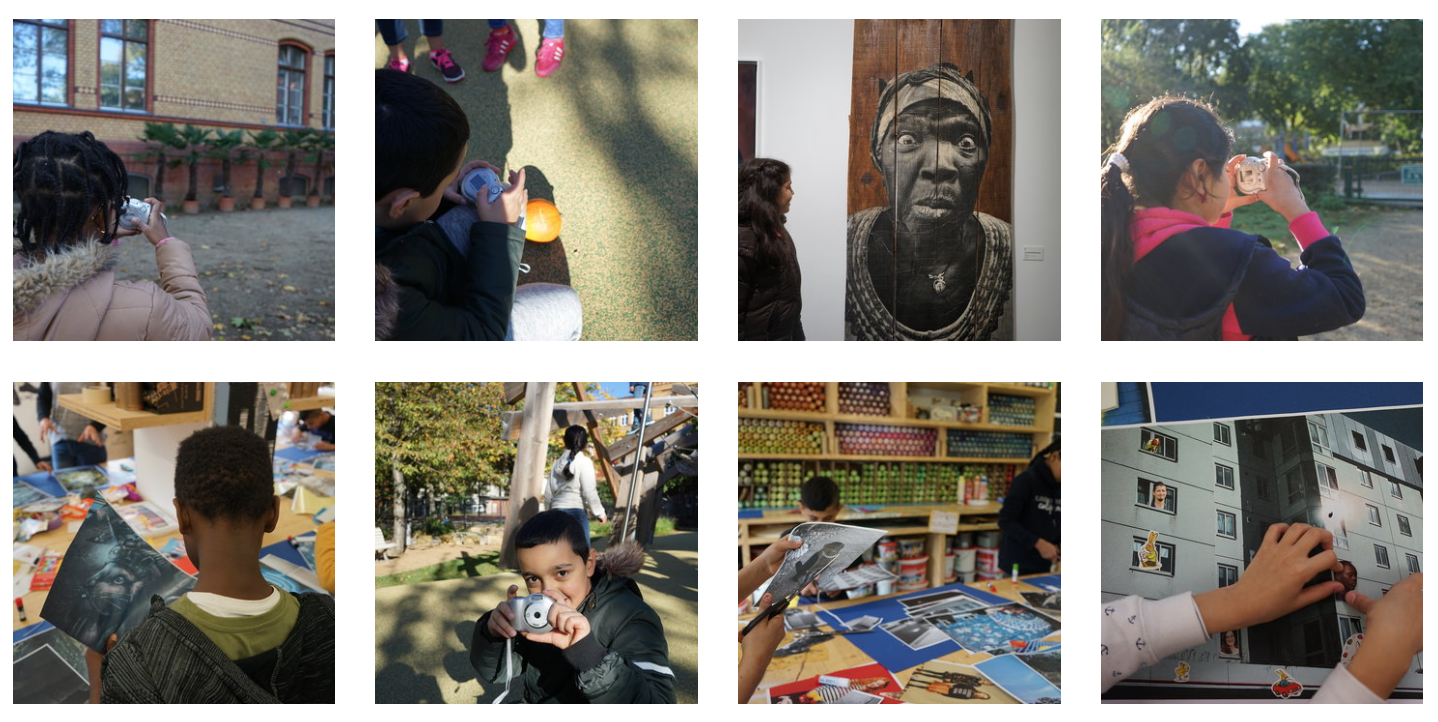
Picture the City’s main objectives were to create playful conditions for kids to explore the medium of photography, to see familiar areas with new eyes, to discover new places of the neighbourhood, to encourage kids to trust their ways of seeing and develop a personal creative process, as well as to visit museums and galleries to see the works of other artists. This workshop took place at Allegro Grundschule, Urban Nation, and the streets of Berlin. Commissioned by KinderKulturMonat in 2016.

Science teaches us to ask questions, to develop a spirit of inquiry, and experiment our ways towards finding responses or directions. Art gives us possibilities to re-invent questions themselves and learn to dance with those that may not have answers. It also offers tools to express ourselves: how we feel and see the world, and to walk our own path. Fusion and connection of these two approaches is the basis of this workshops series. Interdisciplinary practices where both brain hemispheres try to be in balance is not only fun but also contributes towards the integration of our fragmented worlds in the broader sense of the word. In collaboration with Olesya Chayka and BubbleScience. Workshops took place at Easybusy Berlin in 2016.


Agora Experiment is a collaboration with Agora experimental self-directed learning school in Roermond, Holland. Aiming to bring movement, body awareness and imaginative storytelling into the learning process, we conducted some workshops directed at training attentiveness as a potential path for children to learn more about themselves, who they are, what they want, what they like and don’t like, what is good for them and what is not, for a learning to be based on self-responsibility and mature awareness.

Donec id justo non metus auctor commodo ut quis enim. Mauris fringilla dolor vel condimentum imperdiet.